Preposiciones en ingles: guia definitiva para dejar de equivocarte
In, on, at, to, for, by: las preposiciones son el error mas persistente. Guia por contexto con los 50 usos mas comunes en ingles laboral.
Las preposiciones son el error más persistente en el inglés de los hispanohablantes. No porque sean difíciles de entender, sino porque muchas veces no tienen lógica directa desde el español. Depends on no es depende de. Interested in no es interesado en (bueno, ese sí). Responsible for tampoco calca.
El problema: no hay una regla universal. Hay patrones, y hay memorización selectiva. Esta guía te da los dos.
Por qué las preposiciones son tan difíciles
En español, las preposiciones también son complicadas, pero las aprendiste de chico sin darte cuenta. En inglés, tenés que hacer consciente ese proceso.
Tres razones por las que nos equivocamos:
-
Falsos cognados preposicionales: I arrived to the office suena lógico desde el español, pero es incorrecto. Lo correcto es I arrived at the office.
-
Phrasal verbs: La preposición cambia todo el significado. Look up (buscar), look for (buscar también pero diferente), look after (cuidar), look into (investigar). Cuatro significados distintos con la misma palabra base.
-
Colocaciones fijas: Algunos verbos, adjetivos y sustantivos siempre van con la misma preposición, sin excepción. No hay lógica, solo uso.
Parte 1: In, On, At para tiempo
Esta es la base. Hay un patrón claro.
IN - períodos largos o generales
- in the morning / in the afternoon / in the evening
- in January / in 2024 / in summer
- in the 90s / in the past / in the future
- in two weeks (dentro de dos semanas - hacia adelante)
Trabajo: I'll send it in the morning. The project starts in Q3.
ON - días y fechas específicas
- on Monday / on Friday
- on March 15th / on my birthday
- on weekdays / on weekends
- on the 3rd of April
Trabajo: The deadline is on Thursday. We launched on March 1st.
AT - momentos exactos
- at 3pm / at noon / at midnight
- at the end / at the beginning
- at the moment (en este momento)
- at the same time
Trabajo: The meeting is at 10am. I'll finish at the end of the week.
Los casos especiales que confunden
| Incorrecto | Correcto |
|---|---|
| in the weekend | on the weekend (AmE) / at the weekend (BrE) |
| at night time | at night |
| in Monday | on Monday |
| on the morning | in the morning |
| in Christmas | at Christmas |
Parte 2: In, On, At para lugar
El mismo patrón, pero aplicado a espacio.
IN - dentro de algo, con volumen
- in the office / in the room / in the building
- in Argentina / in Buenos Aires
- in a meeting (dentro de la reunión)
- in a team / in a company
ON - sobre una superficie, en contacto
- on the desk / on the screen / on the wall
- on the second floor
- on the website / on Slack / on LinkedIn
- on the phone / on a call
Muy importante: on Zoom, on Teams, on a video call - siempre ON para plataformas digitales.
AT - punto específico, ubicación funcional
- at the office / at the airport / at home
- at the front desk / at reception
- at the meeting (presente en la reunión)
- at your desk
La distinción in/at para meetings
Esta confunde mucho:
- I'm in a meeting - estoy dentro de la reunión, es el contexto donde estoy
- I was at the meeting - asistí a esa reunión específica
Ambas son correctas pero implican perspectivas distintas. Para decir que estás ocupado: I'm in a meeting. Para decir que asististe a algo: I was at the meeting.
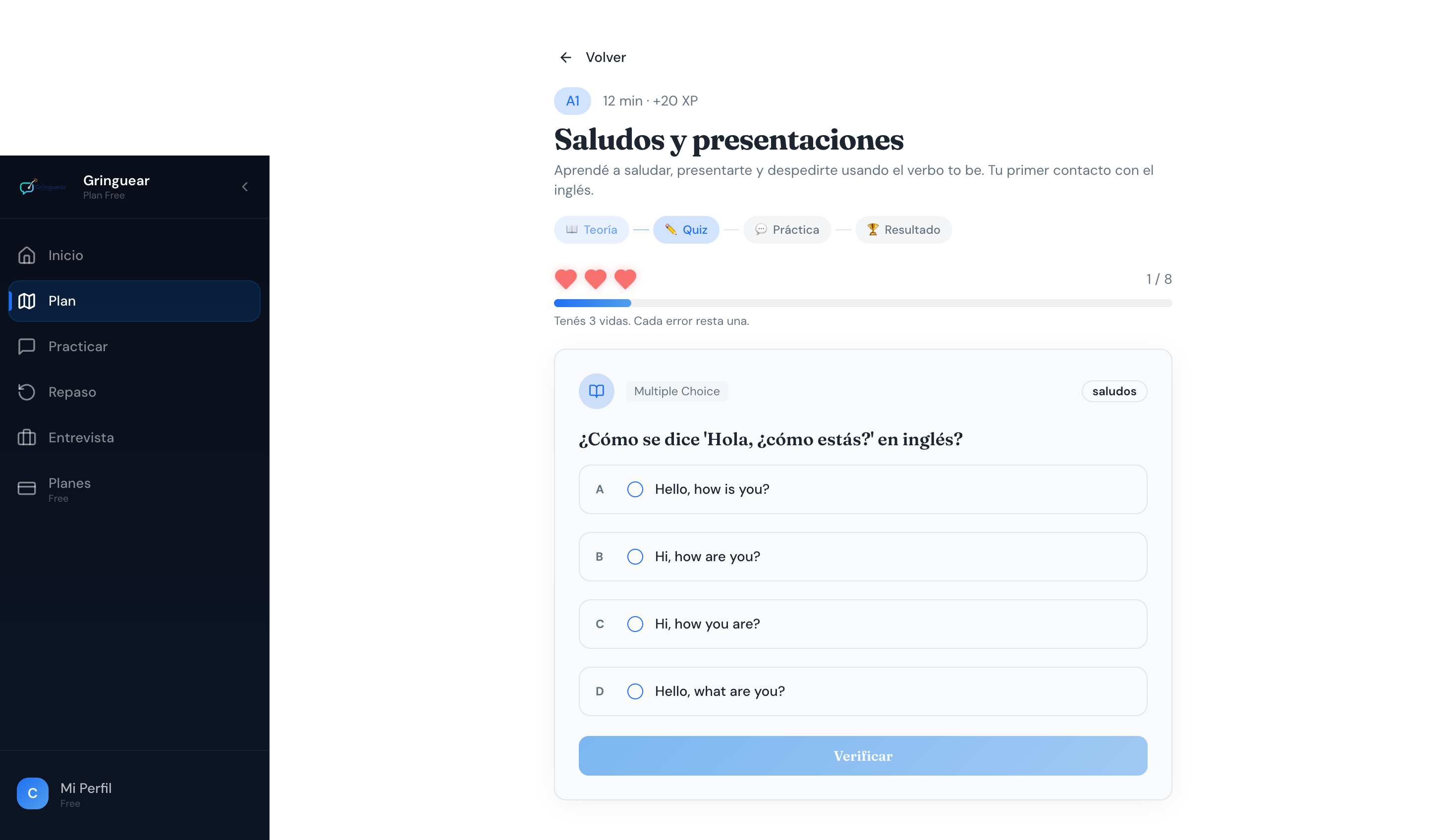
Practica gramatica en contexto
Ejercicios interactivos que te muestran la gramatica en situaciones reales de trabajo, no en frases artificiales.
Ver las leccionesParte 3: Las colocaciones fijas - los 50 más comunes
Estas son las preposiciones que van fijas con ciertos verbos y adjetivos. No hay lógica; hay que aprenderlas.
Verbos + preposición (los más usados en trabajo)
| Verbo + Prep | Ejemplo |
|---|---|
| agree with | I agree with your approach. |
| agree on | We agreed on the timeline. |
| apply for | She applied for the position. |
| ask for | Can I ask for your feedback? |
| deal with | I'll deal with the client. |
| depend on | It depends on the deadline. |
| focus on | Let's focus on the main issue. |
| listen to | Thanks for listening to me. |
| look for | I'm looking for a solution. |
| look into | I'll look into it. |
| report to | She reports to the VP. |
| respond to | Please respond to this email. |
| result in | This will result in delays. |
| specialize in | We specialize in fintech. |
| subscribe to | I subscribed to their newsletter. |
| talk to/with | I talked to the team. |
| work on | I'm working on the proposal. |
| work with | I work with the design team. |
Adjetivos + preposición (muy frecuentes en inglés laboral)
| Adjetivo + Prep | Ejemplo |
|---|---|
| afraid of | She's afraid of presenting. |
| aware of | Are you aware of the risk? |
| capable of | Is the system capable of this? |
| concerned about | I'm concerned about the timeline. |
| different from | This approach is different from what we tried. |
| excited about | I'm excited about the launch. |
| familiar with | Are you familiar with React? |
| good at | She's good at presenting data. |
| interested in | I'm interested in the role. |
| involved in | Who's involved in this project? |
| proud of | We're proud of what we built. |
| responsible for | Who's responsible for this? |
| satisfied with | The client is satisfied with the results. |
| similar to | This is similar to what we did last year. |
| tired of | I'm tired of this bug. |
| worried about | I'm worried about the deadline. |
Sustantivos + preposición
| Sustantivo + Prep | Ejemplo |
|---|---|
| an increase in | There was an increase in bugs. |
| a decrease in | We saw a decrease in churn. |
| a solution to | We found a solution to the problem. |
| a reason for | What's the reason for the delay? |
| a demand for | There's high demand for this feature. |
| experience in/with | She has experience in product. |
| interest in | There's interest in partnering with us. |
Parte 4: Errores específicos del español rioplatense
Estos son los errores que más frecuentemente hacen los hablantes del Río de la Plata:
"Arrive to" vs "arrive at/in"
Incorrecto: I arrived to the meeting late. Correcto: I arrived at the meeting late.
- Arrive at para lugares específicos: oficina, reunión, aeropuerto
- Arrive in para ciudades o países: I arrived in Buenos Aires.
- Nunca arrive to
"Married with" vs "married to"
Incorrecto: She is married with a developer. Correcto: She is married to a developer.
"Enter to" vs "enter"
Incorrecto: Please enter to your username. Correcto: Please enter your username. (sin preposición)
"Discuss about" vs "discuss"
Incorrecto: We discussed about the budget. Correcto: We discussed the budget. (sin preposición - discuss ya lleva el objeto directo)
Pero: We talked about the budget. (con talk sí va about)
"Explain me" vs "explain to me"
Incorrecto: Can you explain me the process? Correcto: Can you explain the process to me? o Can you explain it to me?
Parte 5: Preposiciones en frases comunes de trabajo
Estas frases aparecen todo el tiempo. Aprenderlas como unidades completas es más eficiente que analizar cada preposición:
Emails:
- I'm reaching out regarding your proposal.
- Please find the report attached to this email.
- I'm writing on behalf of [nombre].
- I look forward to hearing from you.
- Thanks for your time.
- I apologize for the delay.
Meetings:
- Let's move on to the next point.
- Going back to what you said earlier...
- I'm on a call right now.
- I'll follow up on this tomorrow.
- We're behind schedule on this.
- We're ahead of schedule.
Updates de proyecto:
- We're on track to finish by Friday.
- This is in line with what we planned.
- There's a bug in production.
- The feature is in development.
- We're working on a fix.
Cómo aprender preposiciones de forma efectiva
No intentés aprender todas las preposiciones de golpe. El cerebro necesita contexto repetido para internalizarlas.
Método 1: Aprenderlas en chunks, no aisladas
En vez de memorizar "responsible - for", memoriza la frase completa más usada: "I'm responsible for the backend." El contexto hace que se pegue más fácil.
Método 2: Crear tu propio banco de frases
Llevá un documento (puede ser en Notion, en Notes, donde sea) donde cada vez que encontrés una preposición que no sabías o que te sorprendió, la anotás con su frase completa. Revisarlo 5 minutos por semana es suficiente.
Método 3: Leer en inglés en tu área
Las preposiciones correctas aparecen naturalmente en artículos, newsletters y documentación de tu industria. Leer con atención activa - no solo para entender el contenido sino para notar el idioma - acelera mucho este aprendizaje.
Método 4: Escribir emails en inglés y revisarlos
Antes de enviar un email en inglés, tomá 30 segundos extra para revisar las preposiciones. ¿Dijiste arrive to o arrive at? ¿Discuss about o discuss? Con tres semanas de este hábito, los errores más frecuentes desaparecen.
Las preposiciones no se aprenden de una sola vez, pero sí se pueden dominar progresivamente. Si querés saber en qué nivel estás y qué aspectos de la gramática necesitás trabajar más, el diagnóstico gratuito de Gringuear te da un mapa claro en menos de 15 minutos: hacé el diagnóstico acá.
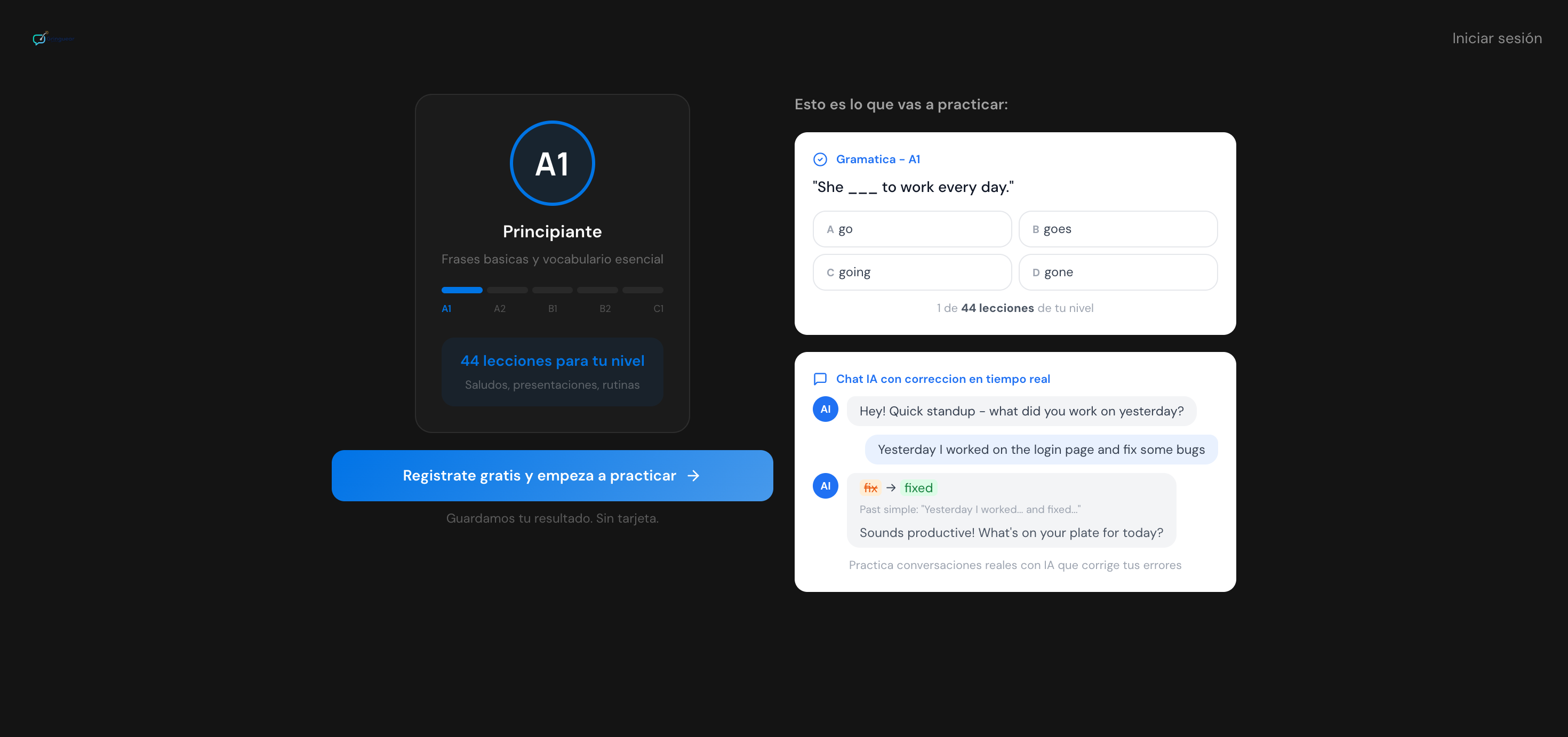
Descubrí tu nivel de inglés en 30 segundos
Diagnostico gratuito con resultado CEFR inmediato. Despues, practica con lecciones y chat con IA adaptados a tu nivel.
Hacer el diagnostico gratisComo hablar de tus fortalezas y debilidades en ingles
7 min de lectura