50 preguntas de entrevista en ingles con respuestas modelo
Lista completa de las preguntas mas frecuentes en entrevistas laborales en ingles. Cada pregunta con respuesta modelo y estructura gramatical clave.
Guarda este articulo en favoritos: es la referencia que vas a querer tener abierta la semana antes de cada entrevista en ingles.
Recopilamos las 50 preguntas mas frecuentes en entrevistas para profesionales tech y de negocios, organizadas por tipo, con una respuesta modelo para cada una. No son guiones para repetir de memoria: son estructuras que podes adaptar a tu experiencia real.
Recordatorio rapido: el metodo STAR
Antes de entrar a las preguntas, recordemos la estructura que mas piden los entrevistadores anglosajones:
- S - Situation: el contexto en que ocurrio algo
- T - Task: que te tocaba hacer a vos
- A - Action: que acciones concretas tomaste
- R - Result: que resultado concreto lograstes
Usalo en todas las preguntas que arranquen con "Tell me about a time..." o "Give me an example of...". Si no tenes un ejemplo perfecto, usa uno aproximado y fijate en el resultado.
Preguntas de presentacion y motivacion
Estas abren casi todas las entrevistas. Tu objetivo: sonar genuino, concreto y entusiasmado.
1. "Tell me about yourself."
Estructura: rol actual + anos de experiencia + logro clave + por que este puesto.
"I'm a backend developer with five years of experience, currently at a fintech startup where I lead our API infrastructure. I've reduced our deployment time by 40% over the past year. I'm looking to join a larger team where I can work on more complex distributed systems - which is exactly what drew me to this role."
2. "Why are you interested in this position?"
Estructura: algo especifico de la empresa + como conecta con tu trayectoria.
"I've been following [company]'s work on [specific product or initiative] for a while. The combination of the technical challenge and the scale of the user base is exactly where I want to grow. My background in [relevant area] feels like a direct fit."
3. "Why do you want to leave your current job?"
Regla de oro: nunca hables mal de tu empleador actual. Enfocate en lo que buscas, no en lo que escapas.
"I've learned a lot in my current role, but I'm ready for a bigger challenge. I want to work on a product that reaches more users and has a stronger engineering culture around [testing / scalability / etc.]."
4. "What do you know about our company?"
Estructura: producto + mercado + algo reciente que muestre que investigaste.
"You build [product] for [market]. I noticed you recently launched [feature or expansion] - that caught my attention because it aligns with trends I've been following in [area]. I also read your engineering blog post about [topic], which gave me a sense of how your team approaches technical decisions."
5. "What are your salary expectations?"
"Based on my experience and market research, I'm targeting something in the range of [X to Y]. That said, I'm open to discussing the full compensation package."
Preguntas sobre fortalezas y debilidades
6. "What's your greatest strength?"
Clave: elegir una fortaleza relevante para el puesto y respaldala con evidencia.
"I'm very good at simplifying complex problems. In my last role, I was the person the team came to when we had architectural decisions to make under pressure. I broke down our migration to microservices into a clear roadmap that the whole team could follow."
7. "What's your greatest weakness?"
Clave: elegir algo real pero no critico para el rol, y mostrar que estás trabajando en eso.
"I used to struggle with delegating tasks - I'd hold on to things because I wanted them done a certain way. I've been working on that by being more intentional about documenting my processes so others can follow them, and I've seen real improvement in how my team operates."
8. "How would your colleagues describe you?"
"They'd probably say I'm reliable and direct. I'm known for following through on what I commit to and for giving honest feedback in a constructive way."
9. "What motivates you?"
"Solving problems that actually affect users. I get a lot of energy from seeing something I built working at scale - especially when it saves people time or makes a process less frustrating."
10. "Where do you see yourself in five years?"
"I'd like to be leading a technical team, either as an engineering manager or as a senior individual contributor with significant scope. I want to keep growing both technically and in terms of the impact I can have on product direction."
Preguntas de comportamiento (Behavioral)
Estas son las que requieren ejemplos concretos. Usa STAR en todas.
11. "Tell me about a time you dealt with a difficult coworker."
"At my previous company, I worked with a senior engineer who was resistant to code reviews. Instead of escalating it, I asked if we could grab coffee and talked about our different approaches. It turned out he felt the reviews were slowing him down. We agreed on a lighter process for small changes and stricter reviews for anything touching core logic. After that, he actually became one of the strongest advocates for the process."
12. "Describe a situation where you failed. What did you learn?"
"We launched a feature without enough load testing and it caused an outage during peak hours. I owned the incident, wrote a post-mortem and implemented a mandatory load testing step in our deployment checklist. We haven't had a similar incident since. The lesson was that 'good enough' testing before launch isn't."
13. "Give me an example of when you went above and beyond."
"A client was about to churn because of a critical bug we couldn't reproduce in staging. I stayed late and set up a mirrored environment that matched their production setup exactly. Found the bug in two hours - a race condition under specific load. We fixed it overnight and retained the account."
14. "Tell me about a time you had to meet a tight deadline."
"We had two weeks to deliver an integration for a key partnership launch. I broke the scope into daily milestones, cut features that weren't critical for v1, and had daily 15-minute syncs with the team to unblock issues fast. We shipped on time with the core functionality, and added the rest in a follow-up release two weeks later."
15. "Describe a time you had to persuade someone to change their mind."
"My manager wanted to use a third-party service for something I thought we could build in-house cheaper and with more flexibility. I prepared a comparison - costs, timeline, long-term maintenance - and presented it in our next one-on-one. He reconsidered, we built it in-house, and it's been one of our most stable components."
16. "Tell me about a time you managed multiple priorities."
"During a product launch, I was simultaneously handling a critical bug fix, onboarding a new team member, and preparing documentation for the launch. I used time-blocking to protect focus time for the bug, delegated parts of the docs to the new hire as a training exercise, and communicated clearly with stakeholders about timelines. Everything shipped on schedule."
17. "Give an example of when you showed leadership."
"When our tech lead left unexpectedly two months before a major release, I stepped up informally. I organized daily standups, kept the roadmap updated, and made sure blockers were escalated quickly. We hit the release date and the experience led to my promotion to tech lead six months later."
18. "Tell me about a time you received difficult feedback."
"My manager told me my code reviews were too long and discouraging for junior devs. That was hard to hear, but I took it seriously. I started framing comments as questions rather than corrections and focused on the two or three most important issues per review. The juniors started engaging more, and the quality of submissions improved."
19. "Describe a time you had to learn something quickly."
"We pivoted to use Kubernetes when I had never used it in production. I took a focused week of study, applied it to a small non-critical service first, then extended it to the main stack over a month. Having a contained experiment before going all-in made the transition smooth."
20. "Tell me about a time you handled a customer complaint."
"A client reported that our analytics dashboard was showing inconsistent data. I took ownership, communicated transparently about what we knew and what we were investigating, and sent daily updates until it was resolved. Turned out to be a timezone offset bug. The client actually praised our communication after the incident."
Preguntas situacionales
Estas plantean escenarios hipoteticos. Muestran tu capacidad de razonamiento.
21. "What would you do in your first 30 days here?"
"I'd focus entirely on listening and learning: understand the codebase, meet the team, read past decision docs, and identify the two or three highest-leverage problems I could start working on. I wouldn't try to change anything before I understand why things are the way they are."
22. "How would you handle a disagreement with your manager?"
"I'd bring it up directly and privately. I'd share my perspective with supporting data and listen to their reasoning. If we still disagreed, I'd ask to escalate to a higher level or propose a time-bounded experiment to test both approaches."
23. "What would you do if you were assigned a task you didn't know how to do?"
"I'd break it into what I know and what I don't, research the unknowns, and ask for help on anything that would take too long to figure out solo. I'd rather ask a question and save two days than stay stuck and miss a deadline."
24. "How do you prioritize your work?"
"I use a combination of impact and urgency. For anything unclear, I ask my manager explicitly. I try to have a single 'most important task' for each day and protect time for deep work in the morning."
25. "How do you handle working under pressure?"
"I break the problem into smaller pieces and focus on the next concrete step rather than the whole thing. Pressure usually feels worse when you're staring at the mountain instead of the next foothold."
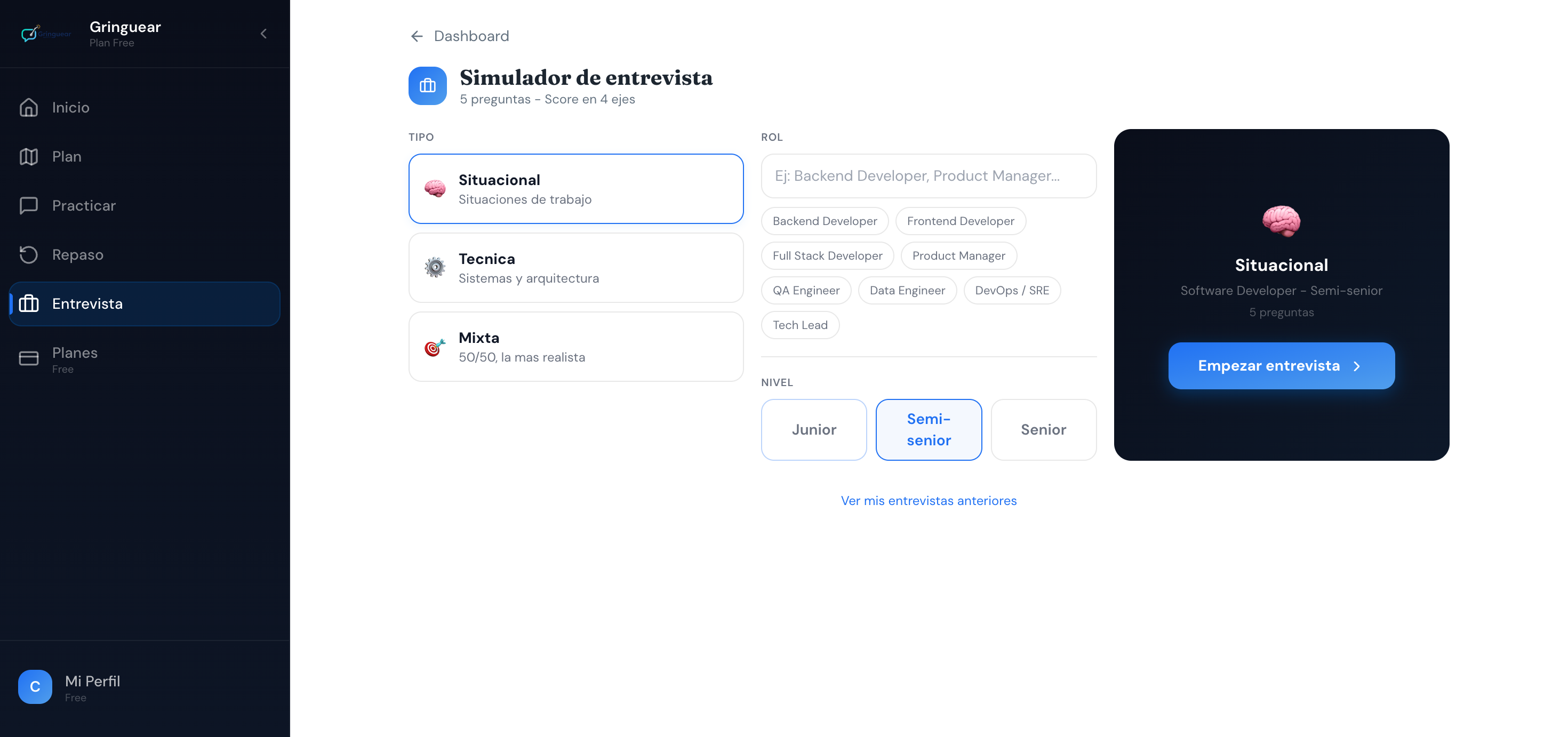
Practica entrevistas con IA
Simula entrevistas reales en ingles y recibe feedback inmediato sobre tu vocabulario, estructura y fluidez.
Probar el simuladorPreguntas sobre trabajo en equipo y comunicacion
26. "How do you collaborate with non-technical stakeholders?"
"I adapt the level of detail to what they need to make a decision. I avoid jargon and lead with outcomes: 'this change means the page loads twice as fast' instead of 'we're implementing lazy hydration'."
27. "Describe your ideal work environment."
"I do best with a lot of autonomy and clear goals. I like knowing why something matters, not just what to do. A team that gives and receives feedback openly is very important to me."
28. "How do you give feedback to a peer?"
"I lead with the specific behavior or output, not the person. I ask questions before concluding. And I always try to have the conversation in private unless it's something the whole team needs to align on."
29. "Tell me about a successful cross-functional project you were part of."
"I worked with design, product, and two engineering teams on a checkout redesign. My job was to make sure the backend changes were compatible with all the frontend variations being tested. I set up a shared integration test environment that all teams could use, which reduced last-minute integration issues significantly."
30. "How do you stay up to date in your field?"
"I follow a few newsletters and technical blogs, listen to podcasts during commute, and try to apply something new in side projects before using it in production. I also check what conferences like [relevant conf] are covering."
Preguntas tecnicas y de proceso
(Adaptables a cualquier area: ingenieria, producto, datos, etc.)
31. "Walk me through your development process for a new feature."
"I start by understanding the requirements and any ambiguities. I write a short technical design doc for anything non-trivial. I build in small increments with tests at each step, do a self-review before requesting peer review, and make sure there's monitoring in place before shipping."
32. "How do you approach debugging a complex issue?"
"I start by reproducing it reliably, then isolate variables systematically. I keep a log of what I try so I don't repeat myself. If I'm stuck after 45 minutes, I ask for a second pair of eyes - talking through it usually surfaces the issue."
33. "How do you ensure code quality?"
"Code reviews, automated tests with meaningful coverage, linting, and documentation for anything non-obvious. The key is consistency - quality processes need to apply to every PR, not just the big ones."
34. "How do you handle technical debt?"
"I track it explicitly and propose addressing it in chunks - usually 10-20% of each sprint. The goal is to keep it from compounding. When technical debt is blocking new work or causing bugs, I make the case to prioritize it explicitly."
35. "How do you make architectural decisions?"
"I define the problem clearly, list the constraints, and evaluate 2-3 options against those constraints. For anything significant, I write an ADR (Architecture Decision Record) so future team members understand why we made the call."
Preguntas sobre metas y crecimiento
36. "What do you want to learn in this role?"
"I'd like to go deeper in [specific area] and get more experience with [tool or methodology]. I'm also interested in growing my skills on the people side - mentoring more junior engineers."
37. "What's your biggest professional achievement?"
"I rebuilt our data pipeline from scratch while keeping the old one running in parallel, without any downtime for users. It took four months of careful coordination and reduced our processing costs by 60%."
38. "What kind of manager do you work best with?"
"Someone who sets clear expectations and gives me space to figure out the how. I appreciate regular feedback and someone who's available when I'm stuck, but doesn't hover."
39. "What are you looking for in your next role that you don't have now?"
"More ownership over technical direction and the chance to work on a product that's growing fast."
40. "Are you interviewing elsewhere?"
"Yes, I'm in conversations with a few other companies. But this role is particularly interesting to me because of [specific reason]."
Preguntas de cierre
Estas suelen venir al final. Son tu ultima oportunidad de dejar una buena impresion.
41. "Do you have any questions for us?"
Nunca digas que no. Tene siempre al menos dos preguntas preparadas. Ejemplos:
"What does success look like in this role after six months?" "What's the biggest challenge the team is facing right now?" "How does the team handle technical disagreements?" "What's your favorite thing about working here?"
42. "Is there anything you'd like to add or clarify?"
"I'd just like to reiterate how excited I am about this opportunity. I think my background in [area] is a strong match for what you're looking for, and I'd love the chance to contribute to [specific team goal]."
43. "When can you start?"
"I have a two-week notice period, so I'd be available starting [date]. If there's flexibility needed, I'm happy to discuss."
44. "Are you comfortable working remotely / in a hybrid setup?"
"Absolutely. I've been working remotely for [X] years and have built strong habits around async communication and documentation."
45. "What questions do you have about the team culture?"
"How does the team communicate day-to-day - is it mostly async? How are decisions made when the team disagrees?"
Preguntas sobre diversidad, inclusion y trabajo en equipo global
46. "Have you worked with international or cross-cultural teams?"
"Yes, most of my career. I've worked with teammates in the US, Europe and Asia. Time zones are manageable with good async practices and overlap hours. Cultural differences are actually something I find valuable - different perspectives lead to better products."
47. "How do you handle communication when English isn't your first language?"
"I've been working professionally in English for [X] years. When I'm unsure of something, I ask for clarification rather than assuming. I've found that being direct about any uncertainty builds trust, not the opposite."
48. "Tell me about a time you worked on a diverse team."
"My last team had members from six countries. We used a lot of written documentation because async worked better across time zones. It forced us to be clearer in our communication, which actually improved the quality of our engineering decisions."
49. "How do you support the growth of junior team members?"
"I try to give them real problems with guardrails rather than trivial tasks. I do code reviews as teaching opportunities - explaining the why, not just the what. And I check in regularly to see if they're blocked."
50. "Is there anything about our job description that concerned you or that you'd like to discuss?"
"I noticed the role mentions [specific requirement]. I don't have direct experience with that, but I've worked with related technologies and I learn new tools quickly. I'd love to understand more about how central that skill is to the day-to-day work."
Errores gramaticales que delatan nerviosismo
Antes de tu entrevista, repasa estos puntos criticos:
- Usa "I have worked" (present perfect) para experiencia hasta ahora, "I worked" (past simple) para un trabajo terminado
- Evita "I am agree" - lo correcto es "I agree"
- No digas "I have 5 years" para la edad o experiencia - es "I have 5 years of experience" o "I've been doing this for 5 years"
- "Actually" no significa "actualmente" (eso es "currently") - significa "en realidad"
- Para dar ejemplos, usa "For instance" o "For example", no "By example"
La mejor forma de interiorizar estas respuestas no es memorizarlas, sino practicarlas en voz alta hasta que las estructuras se vuelvan automaticas. Si queres practicar entrevistas simuladas con feedback de IA sobre tu ingles y tu estructura de respuestas, empeza con el diagnostico gratuito de Gringuear y accede al simulador de entrevistas adaptado a tu nivel.
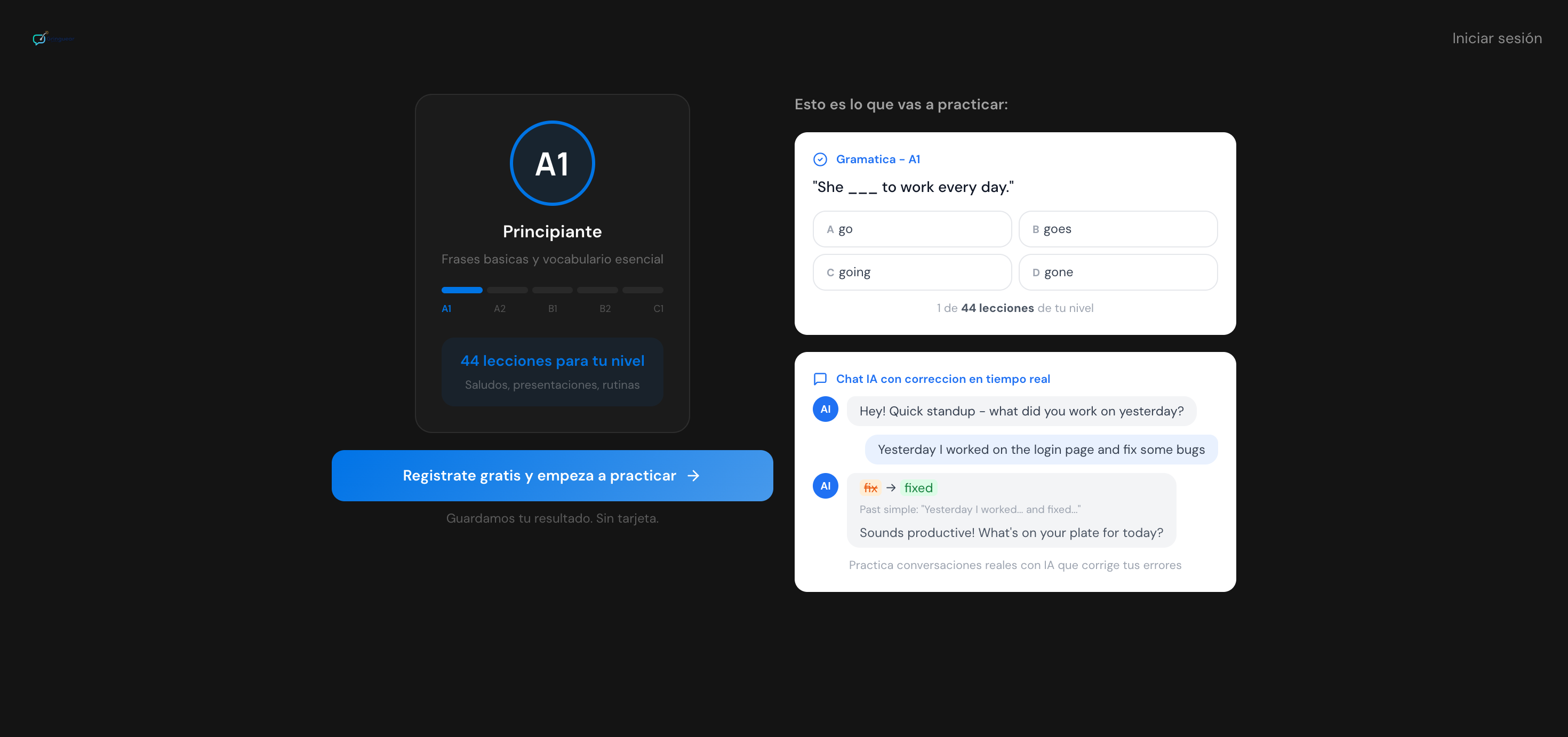
Descubrí tu nivel de inglés en 30 segundos
Diagnostico gratuito con resultado CEFR inmediato. Despues, practica con lecciones y chat con IA adaptados a tu nivel.
Hacer el diagnostico gratis